
Zingerman’s Awning & Rocket’s French Onion Beef Tenderloin
Vic Socotra | Cooking for a Crowd
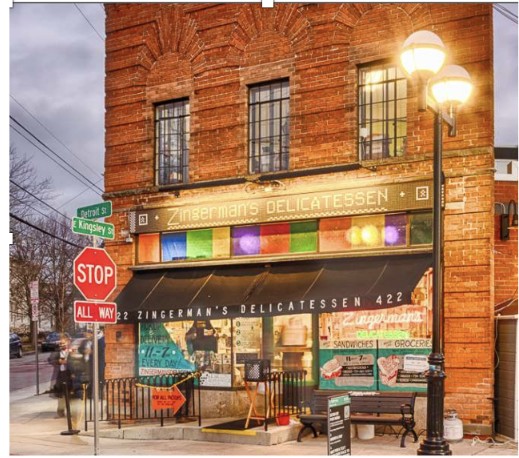
We need to speak honestly for a change. Our Boomers never walked beneath this particular awning at Zingerman’s Delicatessen at 522 Detroit Street in Ann Arbor. Holly and Vic went to school there and can claim time under the one erected in the 1930s, but the successor that just wore out was from 1984 and begins Vic’s Ann Arbor story about the restoration.
That one started as a look into my alternate Socotra Galley buying strategies after I get the quarterlies out of the way and approved bt finabce. I do some smaller specialty purchases as supplements to the ordinary Galley provisioning. Zingerman’s, at 422 Detroit Street in Ann Arbor, belongs in that discussion.
The address alone gives our Michigan contingent something to talk about before anyone opens the shopping list.
Then the awning distracted us.
Zingerman’s own account dates the later weathered covering to the late eighties, which makes the original seem pretty threadbare in Vic;s time and it seemed sort of ochre.
When the staff replaced it in June 2026, they re-created the hand-painted lettering on the 1984 canvas and repaired the vintage mechanical hardware. A number on the mechanism led them to a 1936 patent for Henry C. Heiser’s tension awning arm, assigned to Cleveland’s Astrup Company. The drawings became their repair instructions.
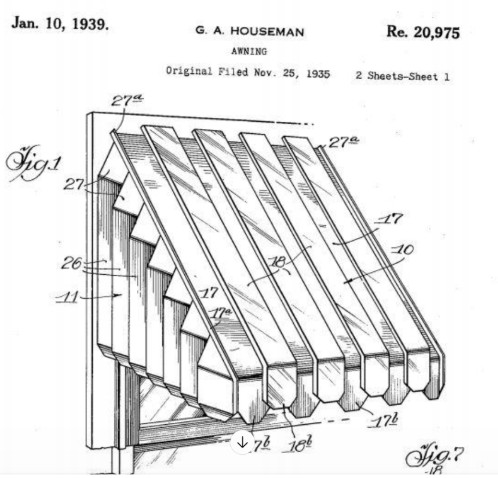
Astrup’s business began in 1876 with Danish sailmaker William J. O. Astrup, making sails for Great Lakes vessels. As the market changed, the company expanded into awnings, other canvas goods, and the hardware that made them work. There is a maritime connection our Conference Room can appreciate without claiming to have helped sew the sails.
Fast Eddie from Legal has a sign saying: “indictments not meaning convictions, and due process must be followed with even guilty people given a right to make their case before punishment” but we used it yesterday and want to keep it fresh.
Our supplier reading also brought us to Vibrant Farms near Baden, Ontario, where the Baer family raises organic grass-fed beef and other meats. That is an interesting producer to study, since their history of farming goes back 200 years on some of their properties, and the literature says they farm in an organic way we like to cook.
Meanwhile, Rocket’s Wyoming Pure order gives us something more immediate to discuss. Tender beef, sweet browned onions, and melted Gruyère can command a Christmas platter or join the Thanksgiving turkey as a second meat. The onions can be done ahead. Someone escaping the Conference Room can handle the potatoes. Rocket gets the beef, a thermometer, and responsibility for watching the cheese.
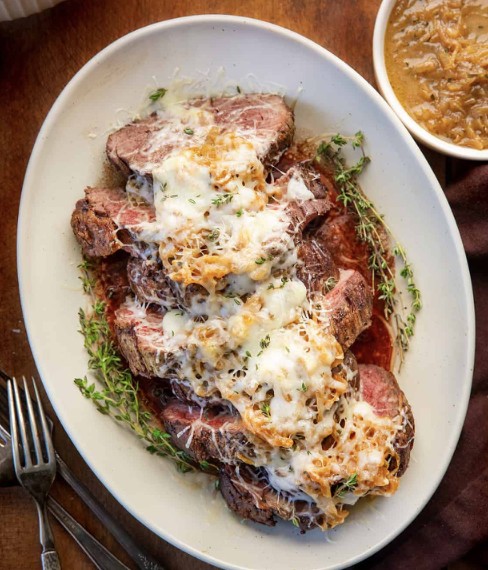
Rockets French Onion Beef Tenderloin
Tender slices of roast beef with caramelized onions, a savory pan sauce, and melted Gruyère. A special dinner with much of the onion work finished the day before.
Serves 8–10 with sides | Preparation 25 minutes | Cooking about 75–100 minutes, with overlapping tasks | Rest 15 minutes
Ingredients
1 trimmed whole beef tenderloin, 4–5 pounds
2 tablespoons olive oil or avocado oil
2 teaspoons kosher salt, plus more to taste; use about half as much if substituting table salt
1 teaspoon freshly ground black pepper
6 tablespoons unsalted butter, divided; keep the final 2 tablespoons cold
3 large yellow onions, thinly sliced
1 tablespoon fresh thyme leaves, plus a little for garnish; or 1 teaspoon dried thyme
½ cup dry white wine, or additional beef broth
1½ cups low-sodium beef broth
8 ounces Gruyère cheese, shredded; Swiss is a suitable substitute
Kitchen twine for tying the roast
For the three or four person watch
Use a 1½–2-pound center-cut tenderloin, 1 tablespoon oil, about 1 teaspoon kosher salt, ½ teaspoon pepper, 3 tablespoons butter divided, 2 medium onions, 1½ teaspoons fresh thyme, ¼ cup wine, ¾ cup broth, and 4 ounces cheese. Use 2 tablespoons butter for the onions and 1 tablespoon to finish the sauce. Follow the same method with these reduced quantities, checking the smaller roast much earlier.
Galley adaptation: completed quantities and method for the ingredient list supplied by Vic Socotra. Narrative, serving plan, and Galley commentary by Vic Socotra and Socotra House Publications. This version has not been kitchen-tested.
Cooking Method
Prepare the beef. Heat the oven to 425°F. Pat the trimmed tenderloin dry. Fold the thin tail underneath and tie with kitchen twine at roughly 1½-inch intervals to create an even shape. Season with the measured salt and pepper. Keep total time at room temperature under two hours.
Caramelize the onions. Melt 4 tablespoons butter in a large skillet over medium-low heat. Add the onions and a small pinch of salt. Cook for 35–50 minutes, stirring regularly, until soft and deeply golden. Reduce the heat if they scorch; a splash of water will loosen browned bits. Stir in the thyme during the final two minutes.
Sear and roast. While the onions cook, heat the oil in a large ovenproof skillet over medium-high heat. Sear the beef on all sides, about 6–8 minutes total. Transfer the skillet to the oven, or move the beef to a roasting pan. Begin checking after 20 minutes for the whole roast, or 12–15 minutes for the smaller watch portion. Continue until a thermometer in the thickest part reads at least 145°F. Time varies with thickness; use temperature to decide.
Rest the beef. Move the roast to a board and tent loosely with foil. Rest about 15 minutes, and at least three minutes, before slicing. Remember that the skillet handle remains hot.
Finish the sauce. Add the wine to the caramelized onions and simmer for 2–3 minutes, scraping up the browned bits. Add the broth and any resting juices from the beef. Simmer for 5–10 minutes, until slightly reduced. Remove from the heat and stir in the remaining 2 tablespoons cold butter. Taste before adding more salt.
Melt the cheese. Heat the broiler. Remove the twine and slice the beef about ½ inch thick. Arrange in a broiler-safe shallow dish, spoon the onions and sauce over it, and scatter with Gruyère. Broil briefly, usually 1–3 minutes, just until the cheese melts. Watch continuously. Without a broiler, use the 425°F oven briefly until melted.
Serve. Garnish with a little fresh thyme and serve promptly. Spoon the onion sauce over the potatoes as well as the beef.
Serving and Keeping
What to serve alongside
For the watch, choose mashed potatoes and one green vegetable, with crusty bread available. A holiday table can accommodate the full procession.
Mashed potatoes: creamy or skins-on, ready to catch the onion sauce.
Green beans: steamed or roasted, finished with a little butter and lemon.
Roasted carrots or Brussels sprouts: color and a change of texture beside the beef.
Crusty bread: a baguette or good country loaf for collecting the sauce.
Green salad: lightly dressed with a tart vinaigrette to balance the cheese and beef.
Quick Tips: Cook the onions and sauce a day ahead, refrigerate promptly, and reheat in a saucepan while the beef roasts. For the best texture, cook the beef fresh and add the cheese just before serving.
Refrigerate leftovers in shallow, covered containers within two hours. Keep at 40°F or below and use within 3–4 days. Freeze meal-size portions with sauce for best quality within 2–3 months; thaw in the refrigerator.
To reheat, place portions in a covered dish with a little broth in a 325°F oven. Heat to 165°F internally. Reheating will cook the beef further, so warm only the portions needed. USDA recommends cooking beef roasts to at least 145°F followed by a minimum three-minute rest.
Questions? Give a shout!
Copyright 2026 Vic Socotra
www.vicsocotra.com
