
Nullification
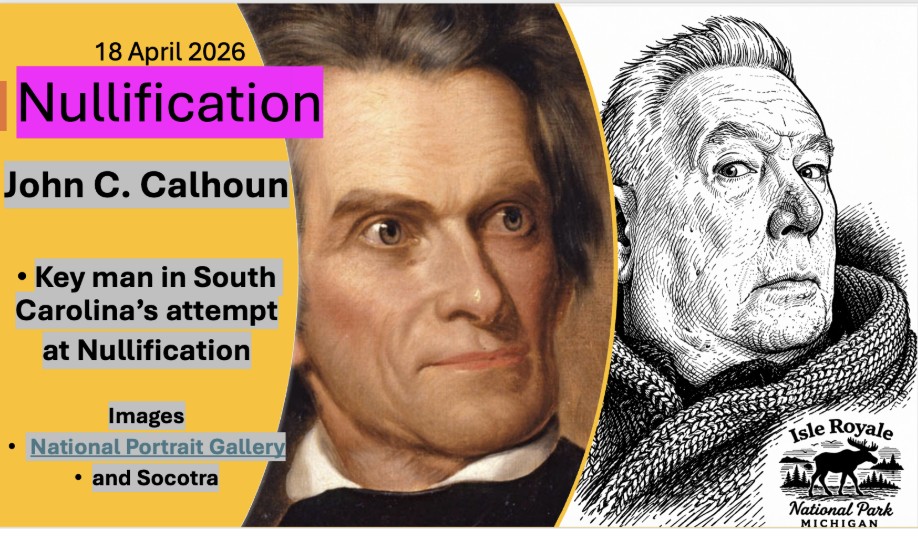
The Weekend Morning Session drifted, as it often does, from bagels and coffee into something a bit more combustible. Miles presides, the Usual Suspects circle up, and before long the conversation takes on that familiar hum—half analysis, half argument, all of it carrying just enough heat to suggest something larger is at stake.
This morning, it was John C. Calhoun who took a seat at the table.
Calhoun, of course, gave us the doctrine of nullification—the idea that the United States was formed as a compact of sovereign states, each retaining the authority to judge, and if necessary reject, federal law. It was tested in the South Carolina crisis of 1832 and put down firmly by Andrew Jackson. The argument didn’t disappear, of course. It rarely does. It simply goes quiet for a while.
We have been having that discussion for a couple hundred years. The volume is up again.
What brought Calhoun back into the room was not history, but Minneapolis.
There has been trouble there for months. Allegations of large-scale fraud schemes involving public benefits have drawn federal attention, and enforcement actions have followed. The scale and specifics are still being sorted out in reporting and in court, but the response has been significant—and emotional.
Some incidents have turned violent. In one case, a woman was shot after reportedly attempting to drive a vehicle at law enforcement. In another, a protester died during a confrontation in which a firearm was discharged. These events have been described in sharply different ways depending on who is telling the story—either as tragic accidents amid chaotic enforcement, or as misconduct by federal agents acting beyond their authority.
And that is where the present begins to echo the past—not in doctrine, but in friction.

Hennepin County Attorney Mary Moriarty, shown above, added a new chapter last week. She announced charges against an ICE agent related to a February incident. The agent, out of uniform and in an unmarked vehicle, is accused of brandishing a weapon while responding to a situation involving motorists. The details remain contested, as they often do at this early stage.
But the significance is less about the individual case than the larger question it raises:
Who gets to decide what lawful enforcement looks like?
This is not nullification in the formal Calhoun sense of a protest against tariffs, an issue also in the messaging. No state has actually declared federal laws void, although the word “Sanctuary” is thrown around. But the underlying tension is familiar. Local authorities, federal agents, and the public they serve are not always aligned in their understanding of legitimacy, authority, or restraint.
That gap—between law on the books and law as experienced—is where the old arguments find new life.
Around the table this morning, you could hear the variations:
Some argue for the primacy of federal authority—law is law, and enforcement must follow.
Others lean toward local control—community standards and local accountability should prevail.
And some drift further still, toward the individual—each person judging which laws deserve obedience.
Three levels of resistance, if you like. None of them new.
Paul Revere rode on this date in 1775 to warn that authority was on the move. The circumstances were different, but the instinct was the same: a suspicion that power, once distant, had drawn too near.
It is not necessary to declare a second civil war to recognize the pattern. That kind of language may satisfy the moment, but it obscures more than it reveals.
What we are seeing instead is something older, and in some ways more persistent:
an ongoing negotiation over where authority resides, how it is exercised, and when it is resisted.
The discussion at the table will continue. It always does.
The volume, however, is up.
Copyright 2026 Vic Socotra
www,vicsocotra.com
