
Digging Up John Paul Johnes

(Clockwise: portrait of Captain John Paul, later Rear Admiral John Paul Jones; daguerreotypes from the 1905 exhumation at the paved-over Cimetière des Protestants Étrangers; and the final crypt at Annapolis.)
The Forgotten Admiral
There is a bunch going on overseas, and America’s ships are enforcing sanctions and maintaining blockades. We will know more about how that effort to protect a sort of peace in a wildly changing world is going. But a quick trip to the naval history locker helps to put things in perspective about things like ‘truth’ and ‘justice.’
For more than a century after his death in 1792 at age 45, the remains of America’s greatest Revolutionary War naval hero lay in a forgotten, unmarked grave outside Paris. The search for him would become one of the great nautical stories of the nation—not for action at sea, but for what followed on land. Two continents. A century underground. Memory deferred.
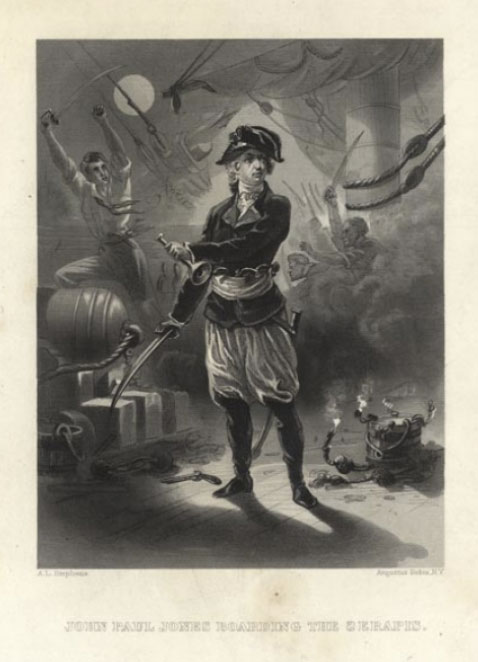
John Paul Jones is sometimes called “The Father of the United States Navy.” He had already lived several lives: merchant sailor (in a trade he found “abominable”), privateer, naval commander. After independence, peace left him without a flag.
When Empress Catherine II of Russia offered him one, he accepted—after Thomas Jefferson gave his assent.
Between Flags
Russia recognized what America already knew: Jones was a fighting sailor. He was granted the rank of rear admiral and served roughly two years, including combat operations on the Black Sea.
But by May 1790, he was back in Paris—ill, with bronchial trouble and likely kidney failure.
Even then, he worked to settle accounts. Letters went out: to his estranged sisters in Scotland, to the French Minister of Marine, ensuring the men of Bonhomme Richard were paid what they were owed.
He died alone on July 18, 1792, face down on a bed in his apartment on Rue de Tournon.
An Unwanted Body
The French, anticipating eventual American interest, placed his remains in a lead coffin filled with alcohol—preserved for return.
But the American ambassador, Gouverneur Morris, refused both custody and payment.
“I had no right to spend money on such follies.”
So it fell to a local French official to see him buried.
There was dignity in the act. A military escort. A formal procession. He was laid to rest in the Protestant St. Louis Cemetery outside Paris—ground reserved for non-Catholic servants of the Crown.
And then, over time, he was forgotten.
Buried Twice
Records vanished—burned in revolutionary turmoil. The cemetery itself was sold, redeveloped, erased. Streets replaced graves.
By 1859, a French writer suggested the site might lie beneath what had become the Rue Grange-aux-Belles.
It was a clue. Not a solution.
The American Who Would Not Let It Stand
In 1899, U.S. Ambassador Horace Porter decided the matter required resolution.
A Civil War general and Medal of Honor recipient, Porter saw something more than neglect. He saw national failure.
“I felt a deep sense of humiliation… that our first and most fascinating naval hero had been lying for more than a century in an unknown and forgotten grave…”
He resolved to find him.
Digging Under Paris
Maps were studied. Property owners negotiated with. Years passed before permission was granted to dig beneath the modern city.
By 1905, excavation began.
Five shafts were sunk. Over eight weeks, skeletons surfaced. Two lead coffins—wrong.
Then, March 31.
Another coffin. Lead. Period correct.
Opened carefully.
Inside: a man. Five feet seven inches tall.
Jones’s height.
Science Confirms the Dead
The remains were taken to the Paris School of Medicine. French and American experts examined the body—remarkably preserved by the alcohol-filled coffin.
Six days of study.
Conclusion:
“The body examined is that of Admiral John Paul Jones.”
After more than a century, the search was over.
The Journey Home
President Theodore Roosevelt acted immediately.
A squadron of four cruisers was dispatched. The remains were sealed in a new lead coffin, draped in the American flag, and escorted with full honors to Cherbourg.
From there, aboard USS Brooklyn.
At the Chesapeake, seven battleships joined the procession.
The nation, at last, received him.
Annapolis
On April 24, 1906, John Paul Jones was formally reinterred at the United States Naval Academy.
A ceremony of state. Roosevelt present. Porter present.
History, corrected.
In 1913, his remains were placed in the marble sarcophagus that rests beneath the chapel today.
Now, and Then
In a time of change, it is worth considering how easily memory yields to time—and how much effort it takes to recover it.
Heroes are not only made in their moment.
They are kept—or lost—by those who follow.
Vic Socotra
Socotra Daily
April 27, 2026
