
60,000 Young Men Visit Spain
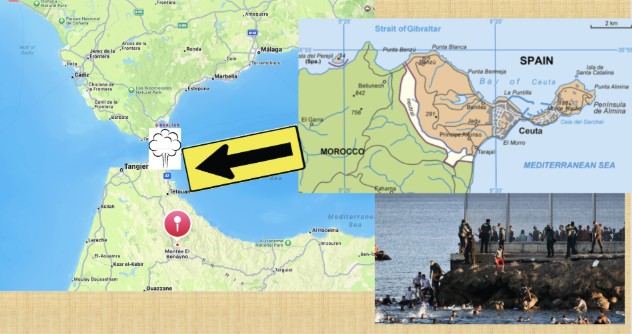
The morning graphic shows the actual location of Spain’s extraordinary immigration crisis. That matters when between 50,000 and 60,000 people- almost all young males of military age- cross the border in two days.
For simple scale of this movement—not as a description of its organization or intent—a modern army battalion may contain roughly a thousand troops. The number of people involved was therefore equivalent to the manpower of about sixty battalions arriving without authorization. Whatever one calls it, that is not routine migration.
It is something else, of course, but the AI program Fast Eddie from Legal says we have to use on the Daily to avoid litigation told us not to use it. Everybody knows.
The Creative Section did not understand the initial reporting yesterday. The headlines often failed to explain which side of the Mediterranean the event was taking place on. Like many readers, our group assumed they meant Spain itself, with thousands of migrants arriving on the European mainland.
Instead, the story centered on Ceuta, Spain’s autonomous city on the African coast.
That matters.
Ceuta is sovereign Spanish territory and part of the European Union, but it is physically located in North Africa. It sits just across the Strait of Gibraltar from mainland Spain and shares a land border with Morocco. Geography still matters, even in an age when headlines move faster than maps.
The strategic implications remain significant. Any mass unauthorized entry into Spanish territory is a challenge for Spain and naturally becomes a European concern. Ceuta’s special border status complicates the usual assumptions about automatic movement through the Schengen Area, but that only reinforces the central point: understanding where something happened is the first step toward understanding what happened.
It is a little like events here in Northern Virginia.
Earlier this year, officials began talking about renewing Washington Dulles International Airport, with work already underway on a new concourse. This week, the President made a much larger announcement about what he intends to do with the sprawling international gateway.
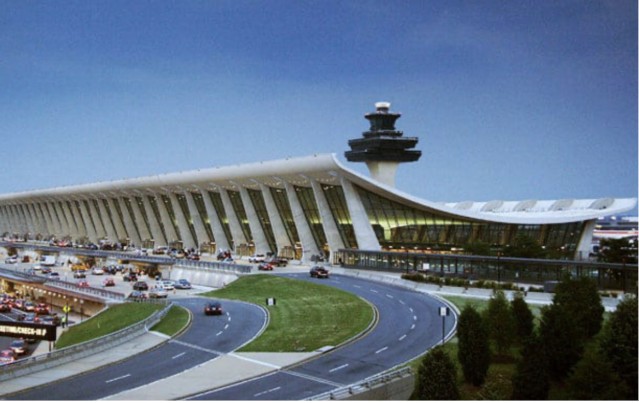
Dulles ought to be connected to the capital by excellent high-speed rail service, with ample parking, comfortable lounges and none of those accursed mobile people movers that once transformed a trip to the airport into an odyssey involving cars, buses, strange rolling rooms—and eventually, if everything worked, an airplane.
The promotional material promises new AeroTrain connections and improved walkability between the terminal and concourses, permitting the retirement of the mobile lounges. It also calls for new and modernized concourses to expand flight capacity and serve more destinations around the world.
When our group was engaged in Global Travel as a means of earning a living, those improvements would have provided a much more relaxed way to exist in this bustling, self-regarding and relentlessly competitive town.
We will let the Zoomers become accustomed to the improvements. Despite the urgency of the President’s announcement, the transformation is expected to unfold over the next decade. LAX is well into its own prolonged attempt to repair its air hub, so we will see.
The other interesting question is what all this will cost.
The announced capital program is worth more than $20 billion. It will not be financed directly through ordinary taxpayer appropriations. The Airports Authority, working with the airlines, plans to finance terminal and concourse construction through municipal bonds, with other portions open to public-private investment.
That much cash—filtered through construction contracts, payrolls, lunches and Happy Hours—means things are going to become fairly exciting around here.

We expect to ride some of the energy generated by Mr. Trump’s astonishing renovation campaign in Washington. The fountains at Metro Center have been returned to white. The great equestrian sculptures at Arlington have been re-gilded. And there is continuing furor over the proposed triumphal arch near the entrance to Arlington National Cemetery, where an estimated twenty percent of the Creative Section intends eventually to be interred.
All this energy devoted to safety, preservation and improved function is rather refreshing. It is also unexpected in a town traditionally devoted to plodding debate.
None of us particularly minds the panoply associated with making the world’s remaining superpower look as though we might actually be enjoying it.
Copyright 2026 Vic Socotra
www.vicsocotra.com
