
Rocket’s Bavarian Beef and the Eagles Nest
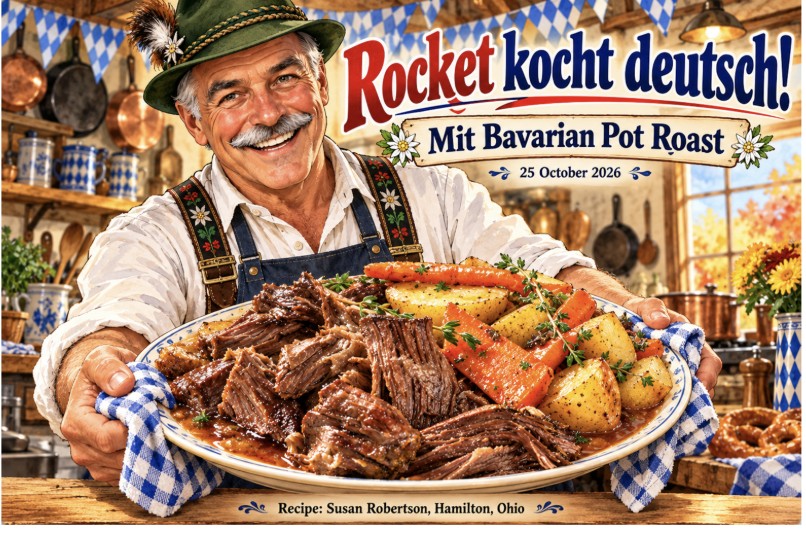
Mit bayerischem Schmorbraten
Bavarian Pot Roast
The discussion this morning promptly headed for Germany. News reports described a devastating fire at the Eagle’s Nest—the Kehlsteinhaus, high in the Bavarian Alps above Berchtesgaden. The blaze began Friday night. Authorities arrested a 33-year-old German man on suspicion of arson; prosecutors reported signs of mental illness. The investigation continues.
Damage estimates run into millions of Euros. Contrary to the first account we picked up, Bavarian officials have already discussed rebuilding, with historians involved in determining how the site should be restored.
That brought a flurry of recollections over Black Rifle Coffee at the Conference Table.
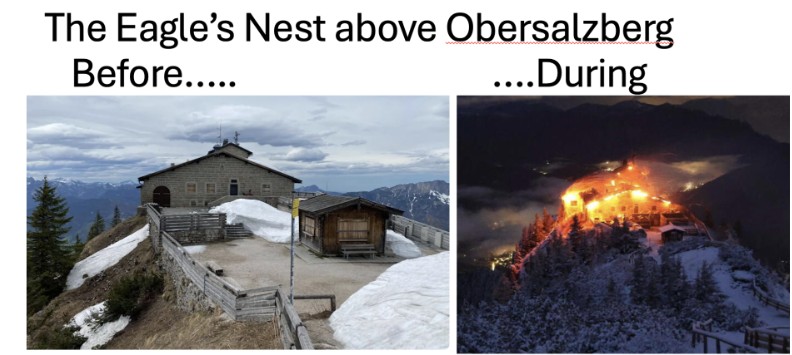
“I’ve been there,” said Arrias. “It was quite a place, set atop a pinnacle in the Alps. You get to it via a spiraling road, then take a tunnel into the mountain, then a brass-lined elevator to the top. The teahouse itself was quite small. There’s a kind of patio or viewing deck.”
Hitler rarely visited the Eagle’s Nest, making much greater use of the Berghof residence farther down the mountain. The two places are easily confused, but they were separate buildings. What to preserve, and how to explain it, will be a matter for the people responsible for these historic relics.
Rocket’s contribution to the German discussion was more immediately useful: Bavarian pot roast.
The recipe comes from Susan Robertson of Hamilton, Ohio, through Taste of Home. She connects it with her German grandparents and the Midwest’s substantial German heritage. Rocket’s Galley version uses our extra-virgin olive oil and comes with au gratin potatoes—the assignment for the interns, following last week’s lesson.
The roast has a gently sweet-and-sour sauce, with beer, tomato, vinegar, cinnamon and ginger.
Give it time at a quiet simmer. The preparation is short; getting chuck roast tender takes patience.
ROCKET’S BAVARIAN POT ROAST
Adapted for the Galley from Susan Robertson’s Bavarian Pot Roast, published by Taste of Home.
Yield: 10 modest servings covers a shift change of 8-12
Prep: 15 minutes
Cook: 2½–3 hours
Total: Approximately 2¾–3¼ hours
Ingredients
2 tablespoons extra-virgin olive oil—our “Wildly Virgin” selection
1 boneless beef chuck roast, about 3 pounds
1¼ cups water
¾ cup beer or beef broth
1 can (8 ounces) tomato sauce
½ cup chopped onion
2 tablespoons sugar
1 tablespoon white vinegar
2 teaspoons salt
1 teaspoon ground cinnamon
1 bay leaf
½ teaspoon ground black pepper
½ teaspoon ground ginger
Directions
Pat the roast dry. Heat the oil in the Lodge Dutch oven over medium-high heat. Brown the meat on all sides, adjusting the heat to keep the oil from smoking. Browning develops flavor; it does not seal in the juices.
In a separate bowl, combine the water, beer or broth, tomato sauce, onion, sugar, vinegar, salt, cinnamon, bay leaf, pepper and ginger.
Pour the mixture over the browned roast. Bring just to a boil, then reduce the heat. Cover and maintain a gentle simmer for 2½–3 hours, or until the meat yields easily to a fork. Allow more time if necessary, and check occasionally that the pot has enough liquid.
Transfer the roast to a cutting board and let it rest briefly. Discard the bay leaf. Slice the beef across the grain, or separate it into serving pieces if it is too tender to slice neatly.
For thicker gravy, simmer the cooking juices uncovered until reduced to your liking. Alternatively, stir in a little cornstarch mixed with cold water and simmer until thickened.
Serve with the au gratin potatoes. That is the way I like it, and the Interns have already had the training.
CAN YOU FREEZE BAVARIAN POT ROAST?
Certainly—assuming Rocket leaves us anything to freeze.
Divide the sliced meat among shallow storage containers and spoon some cooking juices over each portion. Refrigerate promptly, within two hours of cooking, then freeze the portions intended for longer storage. Refrigerated leftovers should be used within the usual three to four days.
I just acquired some stainless storage tubs, which should help turn leftovers into new entrées. Those are for storage. For microwave reheating, transfer the food to a microwave-safe dish.
Thaw frozen portions in the refrigerator. Reheat, covered, with a splash of broth if needed. Turn the meat and stir the gravy during heating, then check that the food reaches 165°F throughout.
A little planning, and Rocket’s German excursion can cover another watch.
Copyright 2026 Vic Socotra
www.vicsocotra.com
