
Memories of Moc’ha
The Sunday Dance-Off
We started Sunday morning considerably farther south and east, watching what could have been the sun coming up over Socotra.
There were thoughts of surf.
Fishing.
Breakfast.
And naturally, coffee.
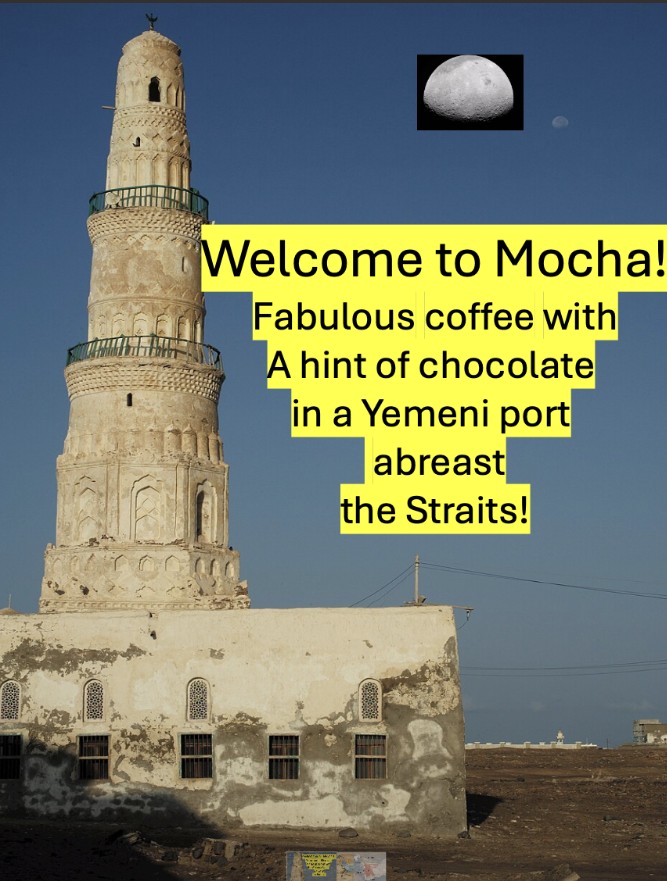
Mocha.
Which turned out to be an unexpectedly useful word this morning.
Across the water from our newly rediscovered island sits the Yemeni port of Mokha, also rendered Mocha or Mukha, which for centuries was one of the great marketplaces of the Red Sea. Coffee grown inland in Yemen—and brought across from Ethiopia—passed through the port on its way outward to an increasingly caffeinated world. It is not the only thing that flows near there. Just to catch you up a bit on the big pipe the Saudis were using to get around the Iranians who are attempting to curtail the flow of oil on tankers through the strait of Hormuz to the north,
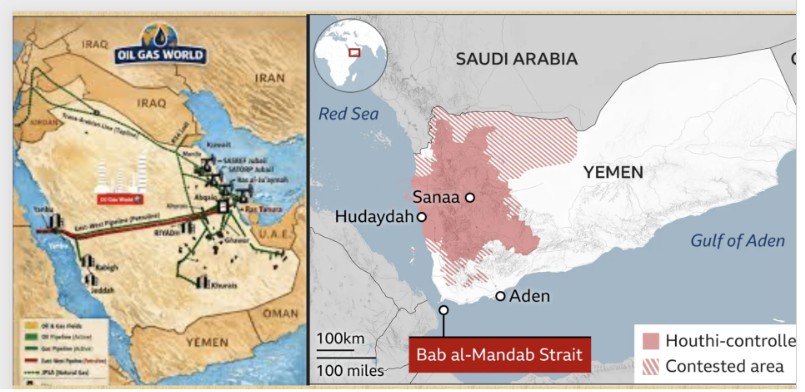
Eventually, when coffee was what was shipped across the desert, the name of the place became the name on the cup. Not EXXON, but Mocha,
That would normally be enough history for a Sunday morning.
Except Mokha is back in the news.
And before getting to that, there is another historical footnote worth mentioning.
The Turks knew the place.
The Ottoman Empire understood the importance of the Red Sea and the Arabian approaches centuries before anybody started talking about container ships, ballistic missiles or barrels of crude.
The Portuguese Jesuit traveler Jerónimo Lobo sailed these waters in 1625. He described Mokha as having once been a place of relatively limited reputation and trade, but said it had become a major city after the Turkish assumption of power in Arabia. Sana’a remained inland. Mokha faced the sea.
That distinction matters.
Empires change.
Geography is considerably more stubborn.
Four centuries later, the Ottoman banners are gone and the people moving down Yemen’s western coast are the Houthis.
Reports say their forces have seized Mokha, returning them to a section of the Red Sea coastline from which they were driven nearly a decade ago. They are also reported to be moving south toward the approaches to Bab al-Mandab.
That is where the pleasant Sunday discussion about coffee gets a little stronger.
Because Mokha isn’t the Strait.
But follow the coast south and the names begin to matter.
Mokha.
Then Dhubab.
Then Mayun, the island also known as Perim.
And then there is nowhere left to go without entering Bab al-Mandab.
Perim sits right inside the Strait. The distinction is important: taking Mokha does not give the Houthis control of Bab al-Mandab. But movement farther south toward Dhubab and Mayun would begin changing the strategic geometry in a much more serious way.
That brings us back to the map we were playing with this morning.
Look east and there is surfin’ Socotra, sitting out in the approaches to the Gulf of Aden.
Look west and there is Bab al-Mandab, the narrow doorway into the Red Sea.
And look farther east again and another familiar name appears:
Hormuz.
The two ends of this story are becoming connected.
Pressure on shipping through Hormuz increases the importance of Saudi Arabia’s Red Sea route. At almost precisely the same moment, the Houthi advance is putting pressure on the old territorial buffer protecting the Yemeni approaches to Bab al-Mandab.
Nobody needed to coordinate that for the geography to become uncomfortable.
Which is probably the useful Sunday lesson.
The Turks understood the doorway.
The coffee merchants understood it.
The British understood it.
The oil men understand it.
The people driving today’s ships through it certainly understand it.
And the Houthis appear to understand it as well.
So do we.
We started the morning with a spectacular sunrise, thoughts of fishing and somebody paddling out into the surf off Socotra.
Then somebody mentioned coffee.
Mocha.
And suddenly we were four hundred years back in the Ottoman Empire—and right back in this afternoon’s Dance-Off.
Funny what can happen before Happy Hour, you know?
Copyright 2026 Vic Socotra
www.vicsocotra.com
