
Events Downstream
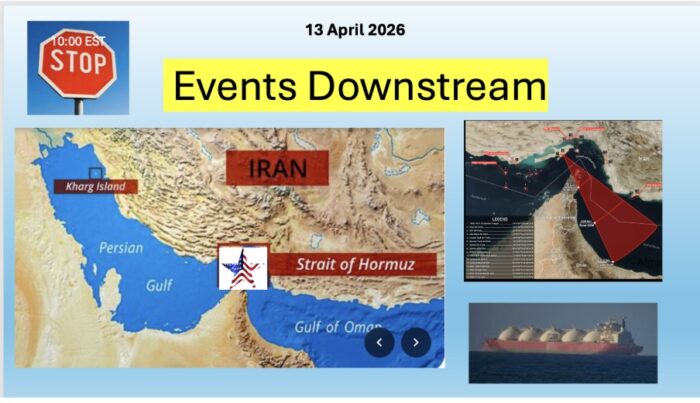
Miles looked at the unusually large crowd in the Conference Room. Watch sections Alpha and Bravo overlapped—one coming, one going—while Charlie lingered out by the Jacuzzi.
Something had hit the STOP sign.
The last transmission confirmed it: blockade imposed at the Strait of Hormuz. Negotiations had broken after nearly a full day at the table. Traffic through the narrow throat of the Gulf—paused, pressured, one misstep from something worse.
Final, but not quite.
It wasn’t good news. Not exactly. But it wasn’t the worst version either.
The U.S. sent Vice President Vance to Pakistan for talks in Rawalpindi. Iran sent its Foreign Minister and the Speaker of Parliament—serious men, but not the usual hard bearded faces. No Revolutionary Guard across the table.
That mattered.
Through the night, Section Bravo tracked the downstream flow—maps lit, shipping lanes traced, tankers idling in uneasy water. The Legacy media drumbeat said we were in over our heads.
Talks ended without resolution. Nuclear questions unanswered. Navigation still contested.
But the line held. The operation stayed tight. No direct casualties.
And Iran was no longer a month away from being able to incinerate its neighbors.
Then came the clip.
Grainy. Brief. Easy to miss.
At departure—just outside the frame of the formal talks—a pause. A turn. A handshake that held a fraction longer than expected.
Forty-seven years, and nothing like it.
We do not expect good news today. The red zone on the chart remains. We would not be surprised by kinetic punctuation in those narrow waters.
But something has shifted.
The STOP sign may not hold forever.
A call for renewed talks could come—not with certainty, but with a handshake. And a cautious path forward, events moving downstream toward a quieter Gulf.
Field Note:
Maritime pressure remains high in the Strait. Diplomatic channel not closed. Blockade in effect in one hour, EST. Watch for signal over noise.
Copyright 2026 Vic Socotra
www.vicsocotra.com
