
A Leak About a Week
For a few hours this week, it sounded as though the Strait of Hormuz might reopen. An unnamed senior Iranian official told Reuters that Tehran could restore passage within seven days if the United States eased military pressure and began lifting its blockade of Iranian ports. The proposal, the official said, had reached Washington through mediators.
Then, Iran’s semi-official Fars News Agency disputed the report. A possible opening had become another question: who in Tehran can make an offer that will stick?
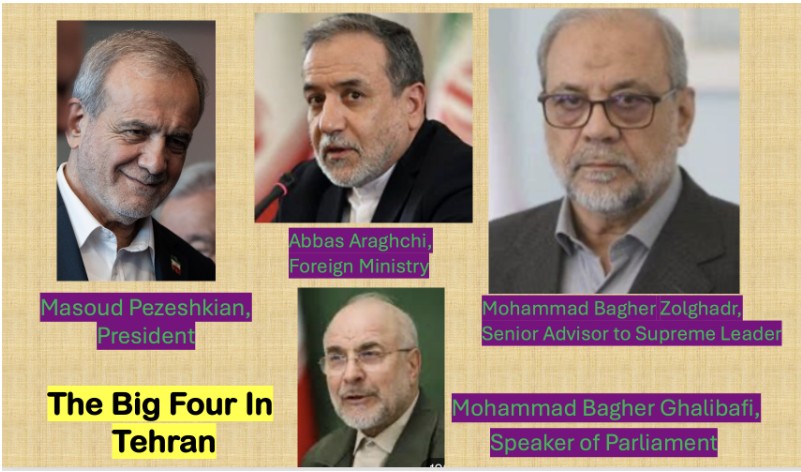
President Masoud Pezeshkian and Foreign Minister Abbas Araghchi are the public faces of Iran’s diplomacy. Parliament Speaker Mohammad Bagher Ghalibaf has taken a harder line on the conditions for reopening the strait. Mohammad Bagher Zolghadr, a former Revolutionary Guard commander, serves as a political adviser to the supreme leader. They appear in the graphic above, though it would be a mistake to assume that four portraits tell us exactly how a decision is made.
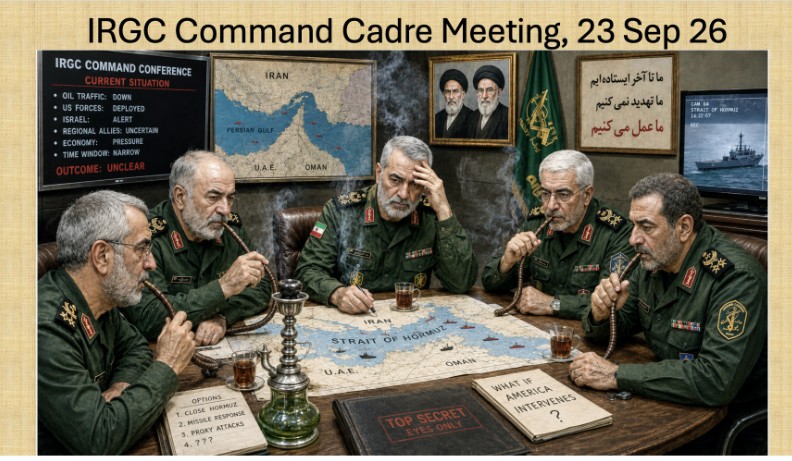
With hardliners all holding formal seats at the table, the regime needs Pezeshkian and Araghchi to be kept visibly in the picture specifically because their public-facing legitimacy is worth something to a regime that still needs to claim popular consent.
Clearly, the IRGC holds the cards, and despite that, Pezeshkian is still pushing for a more moderate approach.
He’s still alive for one reason: The IRGC needs him to preserve the illusion of legitimacy. That is also something useful here as we lurch toward the mid-term elections here. Tehran clearly is hoping for a turnover in the House and possibly the Senate, and if they can play this out for another six weeks it might give them an advantage in negotiations, assuming there is anyone we can find to talk to after the annihilation.
Put plainly, the messaging coming out of Tehran this Big Week is exactly what you’d expect from a regime managing weakness rather than strength — walking back a leak that looked too accommodating the moment it hit international wires. That is precisely because Pezeshkian’s “heads held high” routine produced for back home media can’t coexist with what amounted, in plain terms, to a public seven-day surrender clock to the Americans.
The IRGC doesn’t care that much about what is on the shelves at the supermarkets. We may see if anyone else does in Tehran!
Copyright 2026 Vic Socotra
www.vicsocotra.com
