
Three Wars- Status
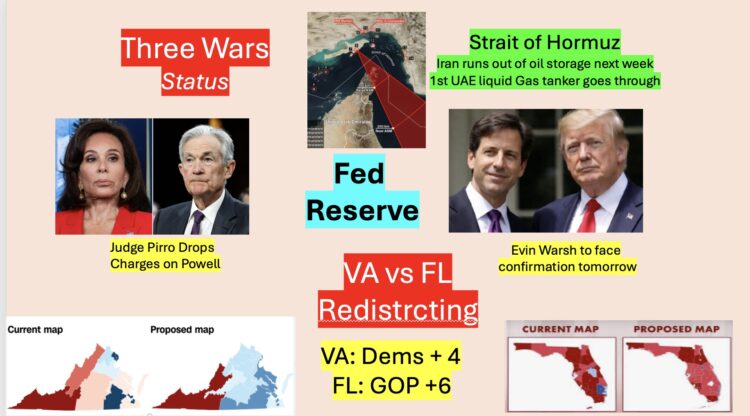
That thing in the Gulf? The hard-line Shia militarists in the Iranian Revolutionary Guard are under mounting pressure. We have supported the oil storage story for three weeks now. Technically, it holds. The Iranians appear to be running short of places to put the stuff, and they are improvising.
They have guns, certainly, but they are also buying time—watching to see whether political events elsewhere might shift their position. In the meantime, older and marginal tankers appear to be pressed into service to keep production flowing.
If they are unable to slow output cleanly, the longer-term risk is damage to the reservoirs themselves. That is not a short-term problem, but it is the kind that can turn strategic resources into something less useful over time. If the pressure continues to build, expect more noise around the Strait in the coming days. We are not going to worry about it today, though we anticipate our interest will pick up by the weekend.
With World News wrapped up for the moment, we turn to another war the Administration appears to be waging—this one at the Federal Reserve.
The Federal Reserve Act was signed into law on December 23, 1913, following a series of financial panics that shook confidence in the American system. The Panic of 1907, once a thunderclap in its own right, has since been overshadowed by the Great Depression and later crises. But at the time, it forced a degree of cooperation that has largely endured for more than a century.
Until now.
There are indications that the long-standing harmony inside the Fed structure may be under strain. Reports suggest movement on legal matters involving Chairman Jerome Powell, which could clear the way for Kevin Warsh to face confirmation. If that occurs, the resulting shift at the top could open a period of internal conflict across the system—the Board of Governors, the regional Reserve Banks, and the Federal Open Market Committee.
We will be watching that closely. Unlike the noise in the Gulf, this one comes with immediate consequences.
Which brings us to the third front—closer to home.
The redistricting battles underway in Virginia and Florida are shaping up as a domestic political war with real implications. In Virginia, Governor Abbie Spanberger moved quickly after taking office to support a temporary redistricting plan that could significantly alter the current balance. Early projections suggest a potential shift favoring Democrats.
Down south, Governor Ron DeSantis is engaged in a similar effort, with proposed changes that could rebalance Florida’s congressional delegation in the opposite direction.
The result is a kind of mirrored conflict—each side adjusting the map to its advantage, each claiming legitimacy, and both likely headed for judicial review.
Among the Socotra Boomers, there is more confusion than outrage. Many have voted consistently for decades and are now watching the mechanics of representation shift beneath their feet. The younger crowd seems less surprised. They have grown up with the expectation that the rules are always in motion.
We asked about recalls here in Virginia, but there is no panic yet. The courts will have their say, and until then, this remains a developing situation.
We will return with updates on that war as events unfold.
In the meantime, the Federal Reserve bears watching. That is the only conflict with active maneuvering in the immediate term—at least until someone in Tehran fully confronts the implications of their current position.
We may know more by next week. And of course, the Iranians could stall themselves into the sand. We have been saying that for 47 years.
Copyright 2026 Vic Socotra
www.vicsocotra.com
Vic Socotra – Purveyor of glib words to the world
jay
