
SPC IAL AFTERNOON EDITION
The south end of the Conference Table rests on stacked cinder blocks.
Vic’s recliner failed this morning. It had been his command chair since the move. Getting it out of the apartment and the matching chair repositioned into the office nook became a major operation — one of those logistical campaigns that feels outsized when mobility is limited.
Splash took the day. for his recovery from the Super Bowl accident he refuses to discuss. The morning production meeting dissolved.
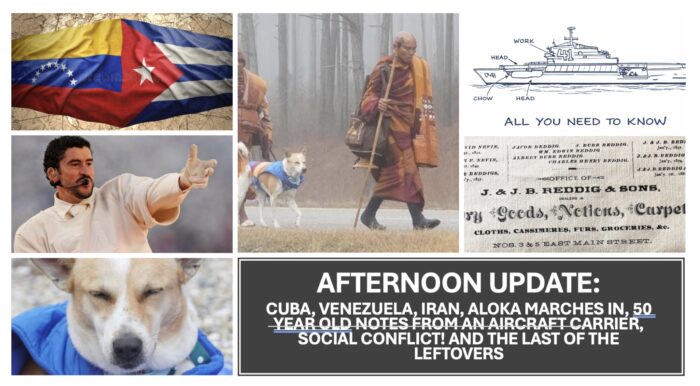
On the north wall screen: drones intercepted over El Paso. Fuel shortages in Cuba. Strike groups repositioning in the eastern Mediterranean. The monks and their dog finishing a 2,300-mile walk from Fort Worth.
“Maybe we need ballast,” Holly said.
And Labrador returned to the table.
Historical Note
The following letter was written in the late 1970s after a visit to Northwest River, Labrador. It reflects the impressions of a young visitor trying to understand a remote community in transition. The observations are personal and immediate — not policy arguments, but witness.
Letter — Northwest River, Labrador
February 11, 1976
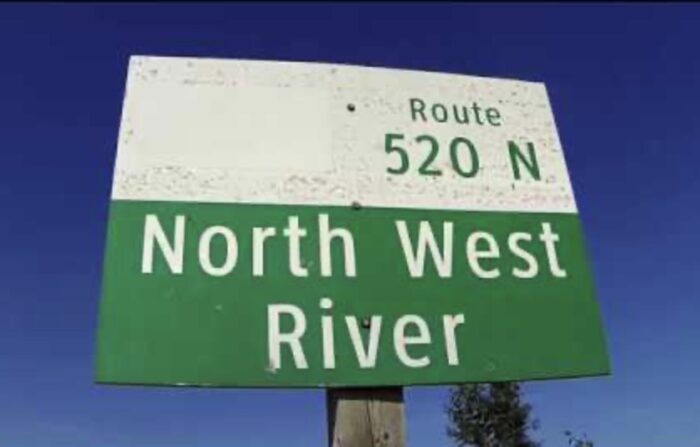
(North West River is a small town located in central Labrador. Established in 1743 as a trading post by French Fur Trader Louis Fornel, the community later went on to become a hub for the Hiudson’s Bay Company and home to a hospital and school serving the needs of coastal Labrador. North West River is the oldest modern settlement in Labrador).
I flew into Goose Bay under a ceiling of low cloud that looked like it had been bolted in place. From there it was a smaller aircraft north to Northwest River, where my friend had taken a teaching post at the Indian school.
The air felt metallic and clear, as if it had never been fully breathed before. The river lay dark and flat, and the spruce trees stood in quiet ranks beyond the modest houses clustered along the shoreline.
The community is proud, but it lives now within a structure shaped far away. Government checks arrive once a month. The liquor store keeps fixed hours. Snowmobiles lean beside porches. Work comes and goes. Some leave for the south and return. Some stay.
In the school the children were sharp and alive, quick with laughter in narrow hallways. There was no lack of intelligence or humor. But outside the classroom, I sensed a tension — between independence rooted in the land and the habits formed by regular assistance.
No one said it plainly. It was present in small things: in conversations about heating oil, about store credit, about waiting.
The river freezes in layers. It does not freeze all at once.
In the evenings we spoke quietly at the kitchen table about how institutions arrive in remote places. First as help. Then as structure. Then as expectation.
I am not certain where that progression ends.
The land here is not hostile. It is not generous. It simply is. The people are much the same.
— [Signed] Vic
2026 Reflection
I would write some of this differently now.
Time alters certainty into questions. What I saw then through the eyes of a young visitor was real — but incomplete. Assistance and autonomy have lived in uneasy balance in many places since that visit. Labrador was not unique. It was simply where Vic first noticed it.
Today, Miles is attempting to be prepared for the headlines speaking of borders tightening, governments straining, and institutions expanding or contracting in crisis. We think of Vic’s ancient words and that quiet kitchen table in the midst of a frontier city and a slow freezing river.
Large forces eventually land somewhere.
They land in classrooms. In store hours. In heating bills. In pride.
The Conference Table may be propped up on cinder blocks this afternoon, but the principle is unchanged.
The river freezes in layers.
Work what you’ve got. There are some very large things in motion.
— Vic Socotra
Letters to the World
Socotra House Publications
Copyright 2026
www.vicsocotra.com
