
The Peaches Are In!
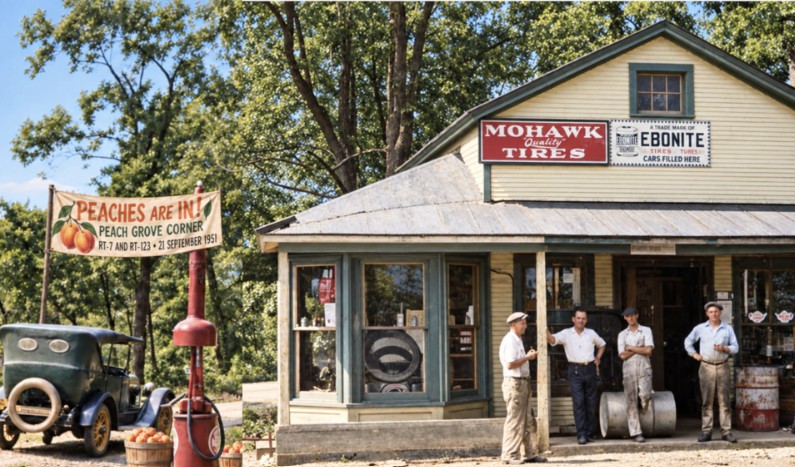
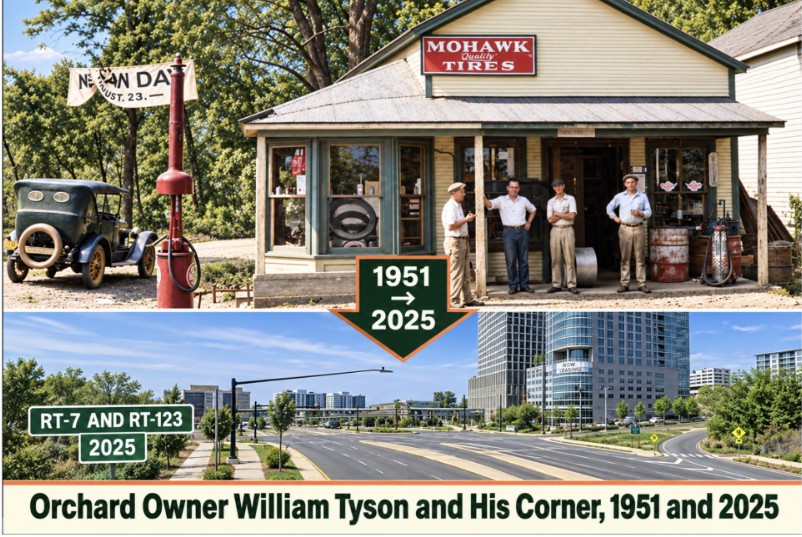
Orchard Owner William Tyson and His Corner, 1951
Peaches in a savory dinner?
Yes, please!
Our pal Amanda has a wonderful recipe for Peach Balsamic Chicken over at her Homestead Site. But hold on for just a second.
Those of us who hang out in a Conference Room about forty feet on the diagonal from where Virginia Route 7 collides with Route 123 ought to explain why fine dining has suddenly met accelerated suburban traffic here in McLean.
The place we call Tysons Corner—or simply Tysons now—was once a sleepy rural crossroads marked by a general store, a post office and acres of farmland. In the nineteenth century, the settlement was known as Peach Grove. William Tyson purchased land there, became postmaster of the Peach Grove Post Office and eventually gave his name first to Tyson’s Crossroads and then Tysons Corner.
By 1951, the year shown in the photograph, Tyson himself had been gone nearly half a century. But his name—and the rural corner that carried it—remained.
Then came the highways, the Capital Beltway, the Dulles Airport Access Road and the enormous new shopping center approved in 1962. The Fairfax County history of Tysons describes the 1960s opening of Tysons Corner Center as the beginning of the crossroads’ transformation into a major commercial center.
Today, we sit amid the result.
The peach trees have been replaced by towers, Metro tracks and enough pavement to keep several generations of civil engineers occupied. Route 7 and Route 123 still meet, although “meet” may be too gentle a word for what happens out there during rush hour.
But there is bigger news:

Naturally, those who love fresh fruit are pretty jazzed by the announcement.
There is another segment of Virginia’s population at least as interested:
The Moonshiners.
Splash stumbled across the subject when spring arrived. He assumed peaches would be ready to pick when everything else on the trees began blooming.
The peaches did bloom.
What he lacked was a smart old lady standing nearby to explain that filling those little blossoms with all that sweet nectar would require several more months of vigorous growth.
The history of ripened fruit is part of the larger history of Virginia agriculture—the soil, orchards and crops that drew English colonists into the rolling green hills we now call home.
Along with the traffic.
Some of that agricultural timeline was bleached by the national disaster of Prohibition. The bloom came off the peach, at least officially, and its public utility was gradually reduced to pies, preserves and the kitchen—not the pint.
We hold that there is room for both.
Amanda has a gazillion recipes suited to nearly every occasion our crowd can invent. She puts a ton of energy into making ordinary kitchen chores fun, tasty and interesting.
She is welcome to cook here any time she likes.

(Amanda and her Pearls)
All right. Here is what started this—and what may never get finished unless somebody finally clicks over and looks at the recipe.
My Chicken with Peaches is a quick sweet-and-savory dinner simple enough to turn over to Splash for a normal shift-change crowd. It combines seared chicken with lightly cooked peaches and finishes with a lemon-honey, balsamic or pan sauce—assuming Splash has not already diverted the sauce into something else.
The combination makes more sense when you remember that Virginia fruit and Virginia spirits have long shared the same agricultural landscape.
Our first President was also a farmer and prominent distiller. George Washington established a commercial whiskey distillery at Mount Vernon in the late 1790s. Its five stills produced nearly 11,000 gallons in 1799, making it one of the nation’s largest distilleries of its time.
We make no such claim for William Tyson. His contribution was lending a name to a crossroads that eventually became one of the most intensely developed patches of ground in Virginia. His contribution to Impaired driving will be reserved for a future and more sober sobriquet.
Still, peach season invites speculation, so here are some quick tips:
Home-Made Hooch Hints for a Ballistic Buzz
For the legal Conference Room version, we are talking about a peach infusion made with commercially produced spirits—not homemade distillation.
Peach spirits naturally taste best with ripe domestic peaches. Genuine Tysons peaches may now be difficult to locate beneath the office towers, but Virginia still grows some fine ones.
Ripe peaches can be combined with legally purchased vodka, whiskey or another commercial spirit to make a sweet summer infusion.
The flavor is highly adjustable. More fruit produces a stronger peach character; additional commercial spirits increase the strength. Serving portions should be adjusted for the age, condition and body mass of those doing the consuming.
A chilled peach infusion makes a refreshing summer drink for gatherings and an impressive homemade gift—provided it is labeled, stored safely and kept away from children.
A non-alcoholic version can be made with peach nectar, tea, lemon, honey and sparkling water.
Patience pays. A peach infusion may be sampled promptly, but resting it under refrigeration allows the fruit and spirit flavors to become better acquainted.
A necessary legal note from the Watch: federal regulations prohibit producing distilled spirits at home except through a properly registered and qualified distilled-spirits plant. Buying a lawful bottle and flavoring it with peaches is an infusion. Operating a still is something else entirely.
Summer in a jar?
A peach infusion is exactly that. C’Mon by!
This sweet and potent little concoction can transform an ordinary gathering into a memorable event with only a few careful sips.
And unlike the original Peach Grove, it will not require the Fairfax County Board of Supervisors to approve another tower.
Copyright 2026 Vic Socotra
www.vicsocotra.com
