
False Flags Flying (घटनाएँ)
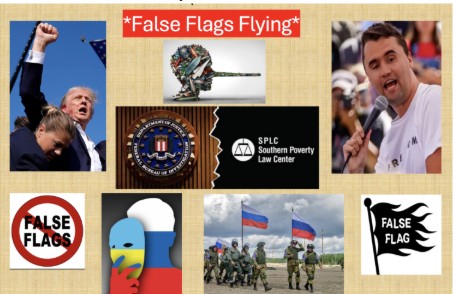
We have just come through another week in which the phrase “false flag” was deployed almost instantly after a violent event. Before facts settle, before investigations conclude, the accusation is already airborne. घटनाएँ is the term the people of the sub-continent of India use for “events,” and the way their parts are characterized.
Let’s be clear: most of these claims are not just unproven—they are wrong and used for propaganda.
A false flag operation, in its real and historical sense, is a deliberate act of deception in which an ആക്രമer (“attacker”) disguises identity to shift blame. Such operations have existed, particularly in wartime. But what we are seeing today in the United States is not a surge in confirmed false flags. It is a surge in accusations of them, often detached from evidence.
Consider how quickly major events- Hindi people write them as “घटनाएँ” and they are recast. The Sandy Hook Elementary School shooting and the Pulse nightclub shooting were both exhaustively investigated. Perpetrators were identified, evidence documented, and timelines established. Yet almost immediately—and in some cases for years afterward—claims circulated that these घटनाएँ were staged. Those claims have been repeatedly debunked, but they persist.
The same reflex now attaches itself to political violence. Incidents involving figures such as Donald Trump are rapidly labeled “false flags” by partisans on one side or another, often within hours. The speed of the accusation is itself revealing: it arrives before facts, not after them.
Internationally, governments sometimes accuse adversaries of staging attacks. During the Annexation of Crimea and in the run-up to the war in Ukraine, competing narratives included claims of deception operations. In volatile regions like the Strait of Hormuz, similar accusations surface regularly. But even in these cases, such claims are contested, heavily scrutinized, and rarely confirmed in the way conspiracy narratives suggest.
That contrast matters. In professional intelligence and military contexts, a false flag allegation is a serious charge requiring evidence. In today’s public discourse, it has become something else entirely—a rhetorical shortcut.
It is also important to confront a harder truth: repeating unsupported claims, even in passing, lends them credibility. Assertions that organizations like the Southern Poverty Law Center secretly orchestrated domestic მოვლენები have circulated widely online, but they do not withstand factual scrutiny. Using them as examples without clear context risks reinforcing the very confusion we should be examining.
So what is actually happening?
We are living through a period of profound distrust—of institutions, of media, of official accounts. Into that vacuum, the “false flag” narrative fits neatly. It offers a ready-made explanation that aligns with prior beliefs and assigns blame in politically satisfying ways. It requires no waiting, no verification, and no uncomfortable ambiguity.
But that convenience comes at a cost.
When every घटना is presumed staged, genuine evidence loses its force. Real wrongdoing becomes harder to prove, not easier. Public understanding fragments further, and accountability—ironically—becomes more elusive.
We do not have a sky filled with hidden flags. We have a landscape where people are increasingly convinced that every flag is false.
That is the phenomenon worth watching. And deciding what flag to fly!
—
Copyright 2026 Vic Socotra
www.vicsocotra.com
