
The Potomac Interceptor

There was excitement at The Trillium with the arrival of Enormous Winter Storm FERN. Nearly 240 million Americans—citizens and non-citizens alike—shared the experience. Light, powdery snow began falling Saturday night, then slowly turned to sleet Sunday morning, sealing the snow beneath it.
The lead photo shows what Monday morning looked like from the 4th floor. You can see the results of nonstop plowing: a massive hump of compacted snow rising where the crosswalk should be.
Pedestrians have been warned to take it easy. Sidewalks are now buried under five or six inches of ice, forcing people to walk into traffic lanes in the major thoroughfares. It’s a prospect that fills us with dread over what casualties may already have occurred.
As meteorologists held our attention and the mounds hardened under freezing rain, consequences followed. D.C. Water crews were deployed to manage a genuine disaster: the collapse of a major wastewater pipeline that sent millions of gallons of raw sewage into the Potomac River just downstream from Tysons Corner.
If it weren’t so numbingly cold, we could probably smell it from here.
The failure occurred along the 54-mile-long Potomac Interceptor line near the Clara Barton Parkway. According to The Post, the interceptor—roughly 60 years old—carries up to 60 million gallons of wastewater daily from McLean near Dulles, through Vienna, Herndon, and Montgomery County, down to the Blue Plains Wastewater Treatment Plant.
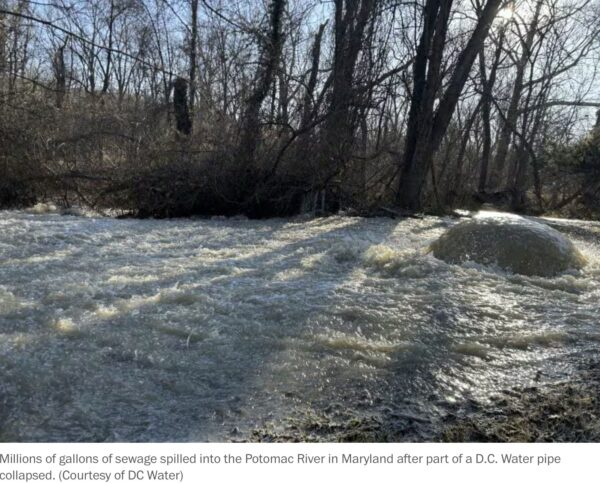
By rough calculation, a week of overflow approaches 400 million gallons. We are pleased to be located north of the collapse, with the breeze blowing down river.
Crews continue working to fully stop the flow. We hope things clear by spring. In the meantime, our river walks will be north and upstream of the rupture.
Blue Plains already has plenty to handle flowing down from The Hill.
Copyright 2026 Vic Socotra
www.vicsocotra.com
